Creating Your Own Rules for Life After Divorce
There is a strange kind of freedom that comes with divorce.
At first, it may not feel like freedom at all.
It may feel like uncertainty. Silence. Responsibility. Too many decisions. Too many opinions. Too many people telling you what you should do next, how quickly you should heal, whether you should date, how you should parent, what you should spend, and what your new life is supposed to look like.
After years of building a life around another person, having the freedom to make your own choices can feel surprisingly uncomfortable.
You may catch yourself wondering:
What am I supposed to do now?
What would everyone else think?
Am I handling this the right way?
But one of the most meaningful parts of life after divorce is realizing that you no longer have to build your life according to rules that were created for an older version of you.
You are allowed to ask a different question now:
What do I actually want my life to feel like?
You do not have to rebuild a life that makes sense to everyone else. You are allowed to build a life that feels true to you.
What Does Life After Divorce Look Like When You Stop Following Everyone Else’s Rules?
There is no single correct way to rebuild your life after divorce.
Your next chapter may be quieter than the life you had before. It may be bolder. Softer. More adventurous. More independent. More private. More peaceful.
Maybe you want to travel alone, move to a new city, change careers, redecorate your home, go back to school, or finally explore the interests you pushed aside.
Maybe you want fewer obligations, slower mornings, stronger boundaries, and a home that feels like a place where you can breathe.
Maybe you do not want to reinvent everything. Perhaps you simply want to keep the parts of your old life that still feel meaningful while releasing the parts that no longer fit.
Creating a new life after divorce does not require you to become a completely different woman.
It means becoming more honest about the woman you already are.
The freedom after divorce is not that you suddenly have all the answers. It is that you finally have permission to begin choosing your own.
Why Can Starting Over After Divorce Feel So Disorienting?
Starting over after divorce can feel disorienting because you are not only adjusting to the loss of a relationship.
You may also be grieving:
- The routines that shaped your days
- The future you thought you were building
- The identity you had inside the marriage
- Relationships with mutual friends or extended family
- Traditions that once made your life feel familiar
- The comfort of making decisions as part of a couple
- The version of yourself you thought you would become
Even small decisions can suddenly feel heavier.
Where should you live?
What traditions should you keep?
How should you spend the holidays?
What should you do on a Friday night when there is no one else’s schedule to consider?
Should you start dating?
Should you wait?
Should you stay in the family home?
Should you sell everything and begin again?
This uncertainty does not mean you are failing at divorce recovery. It means you are learning how to hear your own voice again.
The process of healing emotionally after divorce often includes periods of shock, grief, confusion, and emotional overwhelm before life begins to feel steady again.
You are rebuilding more than a schedule. You are rebuilding trust in your ability to lead yourself.
Whose Rules Are You Still Living By?
Some of the rules shaping your life may be so familiar that you do not even realize they are there.
They may sound like:
- A good mother always puts herself last.
- A divorced woman should stay single for a certain amount of time.
- You should be over it by now.
- Starting over means you failed.
- Being alone means something is wrong.
- You have to explain every decision to your family.
- You should keep the peace, even when it costs you yours.
- You should date again so your ex knows you have moved on.
- You should never trust anyone again.
- You should maintain every tradition for the sake of appearances.
- You should make your new life look successful online.
These rules may come from your marriage, family, religion, culture, social media, motherhood, your ex-partner, mutual friends, or a younger version of yourself.
Some may have once protected you or helped you feel accepted. That does not mean they still belong in your life.
A helpful place to begin is by asking:
Who taught me this rule, and does it still serve the woman I am becoming?
You may discover that some of the pressure you feel is not coming from what you truly want. It is coming from what you have been taught a woman in your position is supposed to want.
Learning to stop living for everyone else after divorce is not selfish. It is part of finding yourself after divorce and rebuilding a life rooted in truth rather than obligation.
You Are Allowed to Create New Rules for Your Healing
Healing after divorce does not need to be rushed, performed, or made comfortable for other people.

You do not owe anyone a polished recovery story.
You do not have to pretend you are thriving when you are still having hard days.
You do not have to forgive before you are ready.
You do not need one final conversation with your ex before you are allowed to move forward.
You do not need to prove that you are happy, healed, unbothered, dating, successful, or better off.
Your healing can be private.
It can be slow.
It can include therapy, journaling, anger, rest, laughter, setbacks, boundaries, new friendships, long walks, and days when all you manage to do is get through.
There may also come a point when finding closure after divorce has less to do with receiving answers from your ex and more to do with deciding that your life is allowed to continue without them.
Your new rule might be:
I will not rush myself to make other people more comfortable.
Or:
I will stop measuring my healing by how little I feel and start noticing how well I care for myself when difficult feelings appear.
That is healing too.
You Are Allowed to Create New Rules for Your Home and Routines
Your home can become one of the first places where you practice making choices that are entirely your own.

Maybe your former home reflected compromises, shared preferences, family obligations, or routines that no longer fit.
Now you get to decide how you want your space to feel.
You might:
- Paint a room a color you have always loved
- Rearrange the furniture
- Remove objects that carry painful memories
- Create a reading corner or creative space
- Eat breakfast in bed on Sunday mornings
- Play music while making dinner
- Replace an old tradition with something new
- Keep the traditions that still bring you comfort
- Make your bedroom feel peaceful and entirely yours
- Stop apologizing for resting in your own home
Your routines can change too.
Maybe mornings no longer need to begin with checking everyone else’s needs.
Maybe dinner does not have to happen at the same time every night.
Maybe holidays can be simpler.
Maybe your weekends can hold both adventure and rest.
Creating new routines while rebuilding after divorce is not about controlling every moment. It is about creating small points of stability that reflect the life you want now.
A new rule might be:
My home does not need to impress anyone. It needs to support me.
You Are Allowed to Create New Rules for Relationships and Dating
There is no perfect timeline for dating after divorce.
You do not have to date because your friends think it would be good for you.
You do not have to join an app because your ex has already moved on.
You do not have to stay single forever because you were hurt.
You do not have to know today whether you ever want another committed relationship.
You get to decide your pace.
You get to change your mind.
You get to establish standards based on what you have learned, not simply what you are afraid of repeating.
Your new rules might include:
- I will not ignore inconsistency because I am afraid of being alone.
- I will not confuse chemistry with emotional safety.
- I will take my time getting to know someone.
- I will not abandon my friendships, routines, or goals for a new relationship.
- I will pay attention to how I feel around someone, not only how much they like me.
- I will not date until the idea feels interesting rather than compulsory.
- I will allow connection without giving up my independence.
Dating can be part of life after divorce for women, but it does not have to become the center of your new life.
A relationship should add to the life you are building, not become the only reason that life feels meaningful.
You Are Allowed to Create New Rules for Money and Independence
Money can be one of the most intimidating parts of starting over after divorce.
You may be handling accounts, bills, insurance, debt, taxes, housing decisions, or financial planning in ways you never had to before.
You may feel embarrassed about what you do not know.
Please remember that not knowing something does not mean you are incapable of learning it.
Financial independence is not built through one giant, fearless decision. It is built through small acts of attention.
You might begin by:
- Checking your bank accounts regularly
- Listing your monthly bills
- Reviewing your credit report
- Creating a simple spending plan
- Learning one financial term at a time
- Asking a trusted professional for guidance
- Setting aside a small emergency fund
- Reviewing subscriptions and automatic payments
- Understanding what is coming in and what is going out
The Consumer Financial Protection Bureau offers helpful budgeting tools for anyone who wants a straightforward place to begin.
Your first budget does not have to be perfect. It only needs to give you a clearer picture of where you are.
Your new rule might be:
I will face my finances with curiosity instead of shame.
Every bill you learn to manage and every decision you make strengthens your confidence.
You are not starting from scratch. You are starting from experience, strength, and everything you are becoming.
Digital and Social Boundaries for Your New Life After Divorce
Social media can make healing feel like a performance.
You may feel pressure to post smiling photographs, inspirational quotes, travel pictures, or evidence that you are doing better without your ex.
You may also find yourself comparing your private pain to someone else’s carefully edited new beginning.
A woman on TikTok may appear to have rebuilt her entire life six months after divorce.
Someone on Instagram may already be dating, buying a house, launching a business, traveling, and posting captions about being happier than ever.
You are seeing moments. You are not seeing the full emotional reality of her life.
Your divorce recovery does not need to look like anyone else’s content.
You do not have to build your new life around how it appears online.
You do not need to post happiness so your ex notices.
You do not have to prove anything to mutual friends.
You do not need to share every milestone while it is still tender.
You are allowed to:
- Mute or unfollow accounts that leave you feeling behind
- Stop checking your ex’s profile
- Keep new relationships private
- Share fewer personal details
- Remove people who no longer feel emotionally safe
- Take breaks from social media
- Protect experiences before turning them into content
Constant comparison and online vigilance can activate your body’s stress response, especially when you are already emotionally overwhelmed.
Your new rule might be:
My life does not need an audience to be meaningful.
How Do You Start Creating Your Own Rules After Divorce?
Creating your own rules does not mean waking up tomorrow with a complete vision for your future.
It begins with noticing what no longer fits and making one more honest choice.
1. Name What No Longer Fits
Write down the routines, expectations, obligations, and beliefs that feel heavy or false.
Ask yourself:
Am I keeping this because I value it, or because I am afraid of disappointing someone?
2. Identify What Feels Peaceful
Pay attention to the moments when your nervous system softens.
Where are you?
Who are you with?
What are you doing?
Peace is not the only guide for decision-making, but it can reveal what feels safe, aligned, and sustainable.
3. Choose One Small New Routine
Do not redesign your entire life at once.
Choose one small practice that supports the woman you are becoming.
It might be a quiet morning coffee, a weekly walk, a Sunday planning session, a solo dinner, or ten minutes of journaling before bed.
4. Set One Boundary
Choose one situation where you have been giving away too much energy.
Your boundary might sound like:
“I am not ready to discuss that.”
“I appreciate your concern, but I am comfortable with my decision.”
“I will not be available that evening.”
“I am keeping that part of my life private.”
5. Make One Decision Without Asking for Approval
Start small.
Choose what to do this weekend.
Buy the bedding you like.
Sign up for the class.
Decline an invitation.
Book the day trip.
Let your own preference be enough.
6. Expect Some Discomfort
Self-leadership can feel uncomfortable when you are used to seeking reassurance.
The discomfort does not automatically mean you are making the wrong decision.
Sometimes it means you are practicing something new.
7. Review and Adjust
Your rules are not permanent laws.
You are allowed to change them as you grow.
A rule that supports you now may not fit two years from now. That is not inconsistency. That is evolution.
Journal Prompts for Creating Your Own Rules in Life After Divorce
Use these prompts to explore what you want your new life to feel like:
- What unspoken rules have shaped the way I believe a divorced woman should live?
- Which parts of my old life still feel meaningful, and which parts am I ready to release?
- When do I feel most peaceful, grounded, and like myself?
- What decision would I make differently if I were not worried about anyone else’s opinion?
- What do I want my home to feel like when I walk through the door?
- What standards and boundaries do I want to carry into future relationships?
- What is one area of my life where I am ready to trust myself more?
- If my next chapter did not need to impress anyone, what would I want it to include?
For more guided reflection, the 7-Day Reset to Help You Find Yourself Again offers a gentle place to begin reconnecting with yourself and thinking about what you want next.
You Do Not Have to Recreate the Life You Lost
Moving forward after divorce does not mean rebuilding the exact life you once had with different people, different furniture, or a different address.
You are allowed to create something new.
Something more honest.
Something quieter, perhaps.
Something stronger.
Something filled with room to rest, explore, change your mind, make mistakes, protect your peace, and choose what matters to you.
You will still receive opinions.
Some people will not understand your boundaries.
Some may question your timeline.
Others may prefer the version of you who was easier to influence, predict, or accommodate.
Their discomfort does not need to become your direction.
This is your life after divorce.
You are the one who has to wake up inside it every morning.
You are the one who gets to decide what stays, what goes, what changes, and what deserves another chance.
You do not have to rebuild a life that makes sense to everyone else. You are allowed to build a life that feels true to you.
And you do not need to create all the rules today.
Begin with one.
Choose one decision you have been seeking outside approval for, and ask yourself what you would choose if you trusted your own voice.
A Gentle Place to Continue
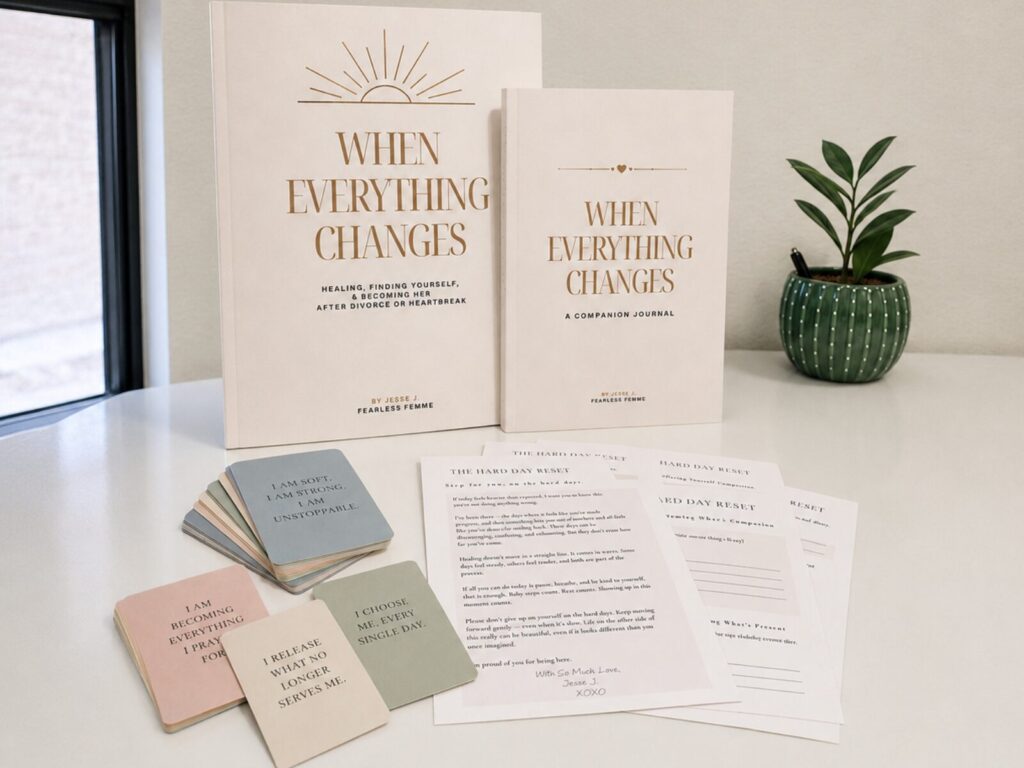
The When Everything Changes workbook offers guided support for processing the emotions of divorce, reconnecting with your identity, gaining clarity, and creating a life that feels like yours again.
You do not need to have your entire future figured out. You only need a safe place to begin listening to yourself.